
On this page
- Does a coach need a qualification?
- Qualification vs accreditation
- ICF credentials explained
- EMCC accreditation explained
- Association for Coaching
- ILM qualifications
- A high-level comparison
- Does the coach need to have been an executive?
- How much experience is enough?
- Does industry experience matter?
- Other qualifications coaches hold
- What HR should check
- How to verify credentials
- Qualifications vs experience
- A practical checklist
- Questions to ask a coach
- Red flags to ask further questions about
- Quick guide
- FAQs
- Conclusion
- Sources and further reading
There is no single legally required qualification that someone must hold before calling themselves an executive coach in the UK. Coaching is not a regulated profession in the way that, for example, law or accountancy is. That doesn't mean qualifications and credentials don't matter. It means buyers need to know what to actually check, rather than assuming a title or acronym on a website tells the whole story.
The strongest way to assess a coach is to look at a combination of formal coach training, recognised professional accreditation, ongoing professional development, relevant experience, and how well the coach's background fits the objective. This guide explains what each of those elements means, what the main credential and qualification routes represent, and what they don't tell you.
This article focuses specifically on the coach's qualifications and credentials. For background on what executive coaching involves more broadly, see CompareHQ's guide on what executive coaching is. If you're weighing up executive coaching against a broader leadership coaching programme, CompareHQ's guide on executive coaching vs leadership coaching covers that distinction. And for what these programmes typically cost, see the UK pricing guide.
1. Does an executive coach need a qualification?
There's no statutory requirement in the UK for someone to complete a specific qualification before working as an executive coach. This is worth being precise about, because it's easy for the point to get overstated in either direction: the absence of a legal requirement doesn't mean training is unimportant, and the presence of a qualification doesn't mean a coach is automatically effective.
Formal coach-specific training matters because it's where a coach typically learns core competencies such as contracting, ethical practice, building trust, structuring a coaching relationship, and the skills that separate coaching from general conversation or advice-giving. Buyers should ask what training a prospective coach has actually completed, who delivered it, and roughly how many hours it involved, rather than assuming any professional background is a substitute.
2. What is the difference between a coaching qualification and accreditation?
This distinction gets blurred constantly in marketing material, and it's worth being precise about it before going any further.
Qualification refers to formal education or training a coach has completed, typically through a course, diploma or certificate programme delivered by a training provider, university, or awarding body.
Accreditation (sometimes called a credential) means recognition granted by a professional body against defined requirements, usually covering training hours, supervised coaching experience, mentor coaching or supervision, and an assessment of competence.
Membership simply means belonging to a professional organisation. Membership on its own doesn't mean a coach has been assessed against that body's coaching standards; accreditation does.
Experience is the coach's actual practical track record: how long they've been coaching, who they've worked with, and in what contexts.
These four things are not interchangeable, and a coach (or their marketing copy) using “certified,” “qualified,” “accredited” and “member” as if they mean the same thing is worth questioning.
Qualification, accreditation, membership and experience
| Term | What it generally means | What a buyer should check |
|---|---|---|
| Qualification | Formal training or education completed | What course, who delivered it, how many hours, what level |
| Accreditation/credential | Recognition by a professional body against defined requirements | Which body, which level, whether it's current |
| Membership | Belonging to a professional organisation | Whether membership alone, or accreditation, is being claimed |
| Experience | The coach's practical track record | Years coaching, typical clients, relevant seniority and context |
Term
Qualification
What it generally means
Formal training or education completed
What a buyer should check
What course, who delivered it, how many hours, what level
Term
Accreditation/credential
What it generally means
Recognition by a professional body against defined requirements
What a buyer should check
Which body, which level, whether it's current
Term
Membership
What it generally means
Belonging to a professional organisation
What a buyer should check
Whether membership alone, or accreditation, is being claimed
Term
Experience
What it generally means
The coach's practical track record
What a buyer should check
Years coaching, typical clients, relevant seniority and context

3. ICF coaching credentials explained
The International Coaching Federation (ICF) is one of the largest global professional bodies for coaching. It offers three core credential levels, each with published requirements covering coach-specific education, supervised coaching experience, and mentor coaching. According to ICF's own credentialing overview:
ICF ACC (Associate Certified Coach) requires 60+ hours of coach-specific education, 100+ hours of coaching experience, and 10 hours of mentor coaching. ICF describes it as the entry credential, demonstrating fundamental coaching competencies and ethical practice.
ICF PCC (Professional Certified Coach) requires 125+ hours of coach-specific education, 500+ hours of coaching experience, and 10 hours of mentor coaching. ICF positions this as suited to coaches with more developed expertise.
ICF MCC (Master Certified Coach) requires the PCC as a prerequisite, plus 200+ hours of coach-specific education and 2,500+ hours of coaching experience. This is ICF's highest individual credential level.
ICF also offers an Advanced Certification in Team Coaching (ACTC) for coaches specialising in team, rather than one-to-one, coaching, which sits alongside these individual credentials rather than above them.
A higher credential level tells you the coach has logged more training and supervised experience hours and been through ICF's assessment process at that level. It does not, on its own, guarantee that a particular coach is the right fit for a particular senior leader's situation. Fit still depends on relevant experience, approach, and the working relationship.
For a closer look at what the credential itself involves, see What Is ICF Coaching Accreditation?.
4. EMCC accreditation explained
The European Mentoring and Coaching Council (EMCC) runs its own accreditation framework, known as the European Individual Accreditation (EIA), which is structured differently from ICF's. It has four levels: Foundation, Practitioner, Senior Practitioner, and Master Practitioner. Each level combines requirements across coaching practice hours, training, supervision, continuing professional development (CPD), and a reflective portfolio assessed against EMCC's competence framework.
In broad terms: Foundation is aimed at coaches at the start of their practice; Practitioner requires a more developed client base and further training hours; Senior Practitioner requires several years of experience, several hundred practice hours and evidence of regular supervision and CPD; and Master Practitioner is EMCC's highest individual level, requiring extensive experience and a demonstrated contribution to the coaching profession. Because exact hour and experience thresholds can be updated, buyers should verify current requirements directly through EMCC's own accreditation documentation rather than relying on secondary sources, including this one.
EMCC's structure isn't a direct equivalent of ICF's ACC, PCC and MCC levels. The two bodies use different frameworks, different terminology and different assessment approaches, so a coach's EMCC level shouldn't be assumed to map neatly onto an ICF level.
For a closer look at what the accreditation itself involves, see What Is EMCC Accreditation?.
5. What about Association for Coaching accreditation?
The Association for Coaching (AC) is another recognised UK-based professional body, with its own individual coach accreditation levels. Based on AC's own published accreditation levels, these include Foundation Coach, Coach, Professional Coach and Master Coach, each requiring a minimum number of coach training hours and logged coaching experience hours (rising from roughly 50+ experience hours at Foundation level up to 1,500+ hours at Master Coach level, alongside client feedback, ethics compliance and continuing professional development).
Notably for this article's purpose, the AC also offers executive-specific variants of several levels (Foundation Executive Coach, Executive Coach, Professional Executive Coach and Master Executive Coach), aimed specifically at coaches working with organisations and senior leaders. This is worth knowing if you see it referenced on a provider profile, since it signals the AC has assessed that coach's practice specifically in an organisational or leadership context, not just general one-to-one coaching.
As with ICF and EMCC, AC accreditation is not directly equivalent to either of the other frameworks, and a higher level doesn't automatically mean a better outcome for your specific situation.
For a closer look at what the accreditation itself involves, see What Is Association for Coaching (AC) Accreditation?.
6. What about ILM coaching qualifications?
The Institute of Leadership and Management (ILM) takes a different approach again. Rather than a credential awarded for logged practice hours and portfolio assessment, ILM offers formal, regulated coaching and mentoring qualifications, commonly at Level 5 and Level 7, delivered through universities and accredited training providers.
ILM Level 5 coaching and mentoring qualifications are broadly aimed at managers with coaching or mentoring responsibilities as part of their role, roughly comparable in academic level to the second year of an undergraduate degree. ILM Level 7 qualifications are aimed at more senior practitioners, including those working specifically as executive coaches or with board-level leaders, and are broadly comparable in level to postgraduate study.
It's worth being careful here: ILM Level 7 is not the same thing as, and shouldn't be assumed equivalent to, an ICF PCC or an EMCC Senior Practitioner accreditation. These are different systems assessing different things, an academic-style qualification structure versus a practice-and-portfolio-based professional accreditation, and no authoritative source establishes a direct equivalence between them.
For a closer look at what the qualification itself involves, see What Is ILM Level 7 Coaching?.
7. A high-level comparison
The table below is an orientation guide to help you understand what you're looking at when a credential or qualification appears on a provider profile. It is not a ranking, and none of these routes should be read as superior to the others.
Coaching credential and qualification routes
| Organisation / route | Examples of credentials or qualifications | What it tells a buyer |
|---|---|---|
| ICF | ACC, PCC, MCC | A professional coaching credential awarded against ICF's published training, experience and mentor coaching requirements |
| EMCC | EIA Foundation, Practitioner, Senior Practitioner, Master Practitioner | Professional coaching and mentoring accreditation assessed against EMCC's own competence framework at different levels |
| Association for Coaching | Foundation Coach, Coach, Professional Coach, Master Coach (plus Executive Coach variants) | Professional coaching accreditation, with some levels specifically assessing organisational or executive-context practice |
| ILM | Level 5 Coaching and Mentoring, Level 7 Coaching and Mentoring | A formal, regulated qualification in coaching and mentoring, assessed at a defined academic level |
Organisation / route
ICF
Examples of credentials or qualifications
ACC, PCC, MCC
What it tells a buyer
A professional coaching credential awarded against ICF's published training, experience and mentor coaching requirements
Organisation / route
EMCC
Examples of credentials or qualifications
EIA Foundation, Practitioner, Senior Practitioner, Master Practitioner
What it tells a buyer
Professional coaching and mentoring accreditation assessed against EMCC's own competence framework at different levels
Organisation / route
Association for Coaching
Examples of credentials or qualifications
Foundation Coach, Coach, Professional Coach, Master Coach (plus Executive Coach variants)
What it tells a buyer
Professional coaching accreditation, with some levels specifically assessing organisational or executive-context practice
Organisation / route
ILM
Examples of credentials or qualifications
Level 5 Coaching and Mentoring, Level 7 Coaching and Mentoring
What it tells a buyer
A formal, regulated qualification in coaching and mentoring, assessed at a defined academic level

8. Does an executive coach need to have been an executive?
Previous experience in a senior executive role can be genuinely useful. A coach who has personally navigated board dynamics, high-stakes stakeholder relationships, organisational complexity or a difficult leadership transition may bring a level of contextual understanding that's hard to replicate otherwise.
That said, it would be inaccurate to claim that former executive status is a requirement for effective executive coaching. Coaching is a distinct skill set from executive leadership itself, and plenty of highly effective executive coaches have built their expertise through coaching training, supervision and extensive experience working with senior clients rather than through having held an executive title themselves. The more useful question for a buyer isn't “were they an executive,” but “does this coach's background and experience genuinely fit what we need them to help with.”
9. How much coaching experience should an executive coach have?
There's no universal number of years or hours that marks the correct threshold for executive coaching specifically. What professional bodies do define are the experience hours required for their own credential levels (as set out in sections 3 to 6 above), which gives you one concrete, checkable data point.
Beyond that, it's more useful to ask about experience relevant to your situation: how many years the coach has been practising, roughly what seniority level their typical clients sit at, whether they've worked on comparable objectives before, and what ongoing professional development or supervision they maintain. A coach with fifteen years of general coaching experience but limited exposure to senior executive contexts isn't automatically a better fit than a more recently accredited coach who specialises specifically in that population.
10. Does industry experience matter?
Sometimes, but not always. Sector-specific experience can be genuinely helpful where an organisation operates in a highly regulated, technical or specialised environment, or where the participant is dealing with challenges that are hard to discuss without some shared context.
It's worth remembering that coaching is not consulting. A coach isn't generally there to provide industry expertise or advise on the business itself; their role is to support the client's own thinking and decision-making. Whether sector experience is genuinely relevant depends on the specific coaching objective, not a blanket rule that industry knowledge is always required.
11. What other qualifications might an executive coach have?
Many executive coaches hold additional qualifications or specialist training beyond core coaching credentials, including backgrounds in psychology, organisational psychology, HR, business or leadership, occupational psychology, or specific methodologies and tools such as MBTI (Myers-Briggs Type Indicator), DiSC, NLP (Neuro-Linguistic Programming), or approaches like LEGO Serious Play.
These can add genuinely relevant knowledge and additional tools to a coach's practice. They aren't, however, a substitute for professional coaching training and accreditation in their own right. A psychology degree or an MBA doesn't automatically make someone a qualified executive coach, in the same way that coaching training doesn't automatically make someone a psychologist. Where a coach references a specialist qualification, it's reasonable to ask how it's used within their coaching practice specifically.
12. What should HR check when reviewing an executive coach's credentials?
Training: What formal coaching training have they completed, who delivered it, and to what level?
Accreditation: Are they currently accredited or credentialed, with which professional body, at what level, and is it current rather than expired or lapsed?
Experience: Who do they typically coach, have they worked with people at a comparable seniority level, and do they have experience relevant to your specific objective?
Professional practice: How do they approach confidentiality, what ethical framework or code of conduct do they follow, and how do they maintain continuing professional development or supervision?
Fit: How are coaches matched to participants, is there a chemistry session before committing, and what happens if the relationship isn't right?
For a fuller procurement-ready assessment framework covering methodology, governance and UK GDPR alongside credentials, see CompareHQ's guide on how to choose an executive coaching provider.
13. How can you verify an executive coach's credentials?
Don't rely solely on a coach's own website or LinkedIn profile to confirm a credential. Where professional bodies maintain a public directory, such as ICF's coach directory, this allows you to check whether a specific credential is genuinely held and current. For EMCC and AC accreditation, and ILM qualifications, ask the provider directly for verification, including the level held and the date it was awarded or last renewed, and don't hesitate to ask follow-up questions if the answer is vague. Distinguishing between “member of” and “accredited by” is worth doing explicitly, since the two are often conflated in marketing copy.
14. Qualifications vs experience: which matters more?
There isn't a clean either/or answer. The strongest overall picture usually combines formal training, a professional credential, relevant coaching experience, experience with comparably senior clients, sound professional conduct, and genuine fit for the specific objective.
An impressive list of credentials doesn't automatically mean a coach is the right choice for your situation. Equally, extensive claimed experience without any evidence of formal coaching training or professional accreditation is worth asking further questions about. Neither qualifications nor experience alone tells the full story; both are inputs into a broader assessment.
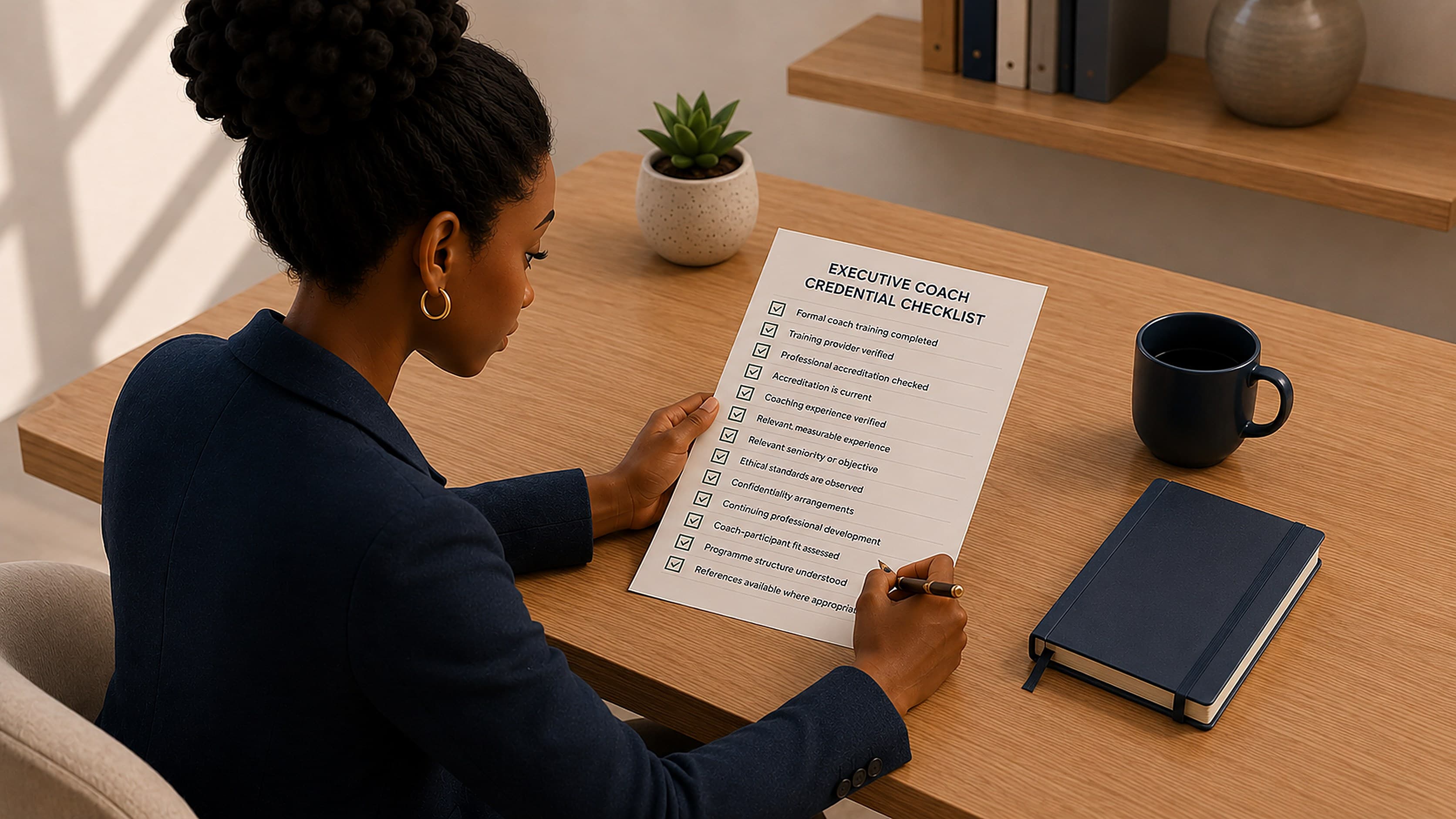
15. A practical checklist for evaluating an executive coach
Checklist: evaluating an executive coach
16. Questions to ask an executive coach
- What formal coaching training have you completed?
- Which professional bodies are you accredited or credentialed with?
- What level of credential do you hold?
- Is your credential current?
- How much experience do you have coaching senior leaders?
- What types of executives do you typically work with?
- Have you coached people facing similar challenges to ours?
- How do you approach confidentiality?
- How do you measure progress?
- What happens if we decide the coaching relationship isn't the right fit?

17. Red flags when reviewing coaching credentials
Worth asking further questions about
Quick guide: what should I look for?
Quick guide
| What you're checking | Why it matters |
|---|---|
| Formal coaching training | Shows structured preparation in core coaching skills |
| Professional credential | Provides an additional, checkable benchmark from a recognised body |
| Relevant experience | Establishes experience with comparable clients and situations |
| Seniority experience | Can be relevant for complex, senior executive contexts |
| Ethical and professional standards | Clarifies how the coach works and what's expected |
| Continuing development | Shows an ongoing, active professional practice |
| Fit | Determines whether the coach genuinely suits the individual and the objective |
What you're checking
Formal coaching training
Why it matters
Shows structured preparation in core coaching skills
What you're checking
Professional credential
Why it matters
Provides an additional, checkable benchmark from a recognised body
What you're checking
Relevant experience
Why it matters
Establishes experience with comparable clients and situations
What you're checking
Seniority experience
Why it matters
Can be relevant for complex, senior executive contexts
What you're checking
Ethical and professional standards
Why it matters
Clarifies how the coach works and what's expected
What you're checking
Continuing development
Why it matters
Shows an ongoing, active professional practice
What you're checking
Fit
Why it matters
Determines whether the coach genuinely suits the individual and the objective
FAQs
What qualifications should an executive coach have?
There's no single mandatory qualification. Look for a combination of formal coach-specific training, a current accreditation or credential from a recognised body (such as ICF, EMCC, the Association for Coaching, or an ILM qualification), relevant coaching experience, and genuine fit for your specific objective.
Does an executive coach need to be ICF accredited?
No. ICF accreditation is one recognised route among several, alongside EMCC, the Association for Coaching, and ILM qualifications. It's a useful, checkable credential, but it isn't the only valid indicator of a qualified coach.
What is the difference between ACC, PCC and MCC?
These are ICF's three core credential levels, each requiring progressively more coach-specific training hours and supervised coaching experience, with MCC requiring PCC as a prerequisite. A higher level reflects more logged training and experience assessed by ICF, not a guarantee of better outcomes for any individual client.
What is EMCC accreditation?
EMCC's European Individual Accreditation (EIA) has four levels (Foundation, Practitioner, Senior Practitioner, Master Practitioner), assessed against EMCC's own competence framework covering practice hours, training, supervision and CPD. It uses a different structure from ICF's credential levels.
Is an executive coach required to have been an executive?
No. Previous executive experience can be relevant context, but it isn't a requirement, and coaching expertise is a distinct skill from having held a senior leadership role.
How important is an executive coach's experience?
Very, but the relevant question is whether their experience matches your specific objective and the seniority involved, rather than years of experience alone.
Can someone be an executive coach without accreditation?
Yes, since coaching isn't a legally regulated profession in the UK. This makes it more important, not less, to check training, experience and professional practice directly.
How can I verify an executive coach's credentials?
Check the relevant professional body's public directory where one exists, ask the provider directly for the level held and when it was awarded or last renewed, and don't rely solely on a website or LinkedIn profile.
Is a psychology qualification necessary to become an executive coach?
No. A psychology background, MBA or similar qualification can add relevant knowledge, but it's separate from professional coaching training and accreditation and isn't a substitute for either.
What should HR look for when choosing an executive coach?
Formal training, current accreditation, relevant and comparable experience, clear confidentiality and ethical practice, evidence of ongoing development, and a matching process that allows for genuine fit, rather than relying on titles or marketing claims alone.
Conclusion
There's no single qualification, acronym or credential that guarantees an executive coach is the right choice. The strongest assessment looks across formal coaching training, a current professional credential, relevant and comparable coaching experience, professional and ethical standards, ongoing development, and genuine fit for the specific objective and individual involved.
Buyers get better outcomes by looking beyond the badge and understanding what actually sits behind it, whether that's an ICF credential, EMCC accreditation, an Association for Coaching level, an ILM qualification, or a specific combination of training and experience. CompareHQ's role is to help buyers understand that information clearly, so decisions can be based on what a credential genuinely represents rather than on how confidently it's marketed. Credentials are only one part of the wider decision; CompareHQ's guide on whether executive coaching is worth it covers the evidence, cost and a practical decision framework.
Sources and further reading
- ICF Credentialing Overview, International Coaching Federation
- EMCC Global, European Mentoring and Coaching Council
- Association for Coaching: Coach Accreditation Levels, Association for Coaching
- CIPD Factsheet: Coaching and mentoring, Chartered Institute of Personnel and Development